
01/21/2025
New Challenge for Film Awards - Generative AI
By Sandra M. Ríos
Twitter: @sandritamrios
A new challenge for Film Awards: Generative AI | Generative and cloning AI have infiltrated the 2024-2025 Awards Season. Should nominations and acting awards be given to performances enhanced by these technologies?
The last Hollywood actors' strike, involving SAG-AFTRA members, lasted 118 days in 2023, with motivations including protecting their craft from the encroachment of AI in audiovisual production. Once concluded, the agreements included several points aimed at setting limits on its use.
Curiously, two of the most resonant works of this awards season, Emilia Pérez and The Brutalist, are at the center of debates for confirming the use of this technology in voice cloning, raising questions for these awards (and festivals) about what is now award-worthy in acting.
Let's revisit what was agreed upon with the studios following the aforementioned strike. From now on, studios are supposed to have explicit consent and pay compensation whenever they use an artist's digital scan, specifying exactly how their image will be used; they also cannot use digital replicas even if the artists have passed away, meaning the rights to their image are inherited by their families. Regarding generative AI, studios cannot create synthetic performances to replace real actors and must have consent to generate voices or likenesses.
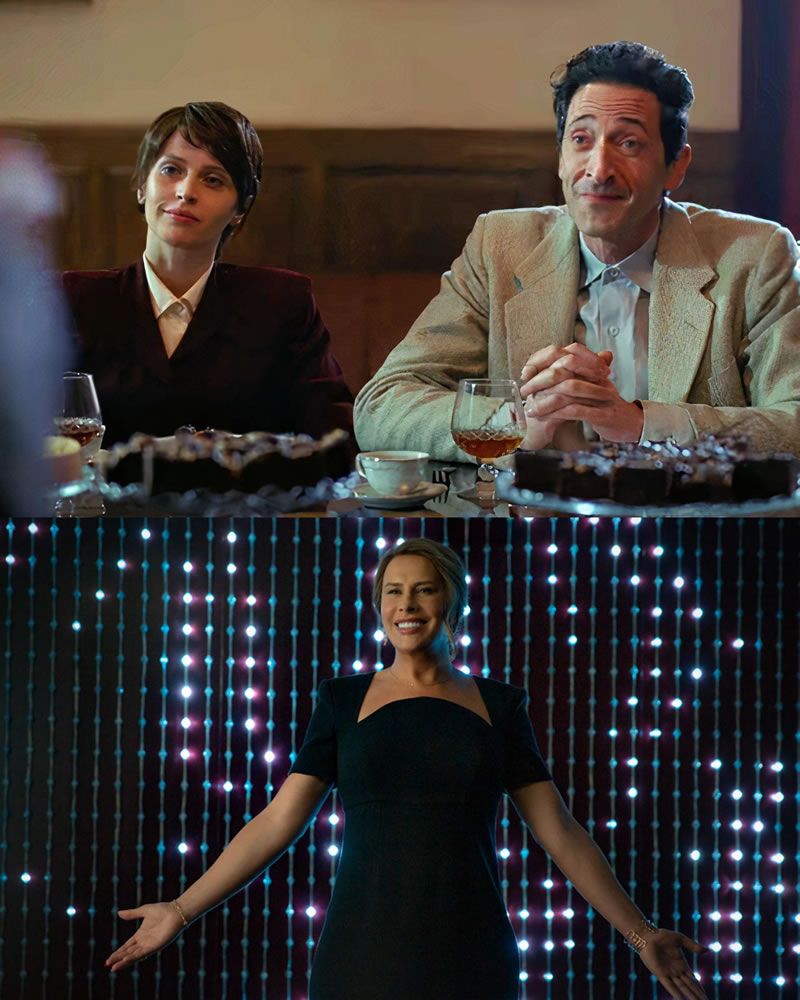
Now, it has recently been confirmed that Emilia Pérez and The Brutalist did use generative and cloning AI in post-production. The first question arises: Did they have the actors' consent? In both cases, AI was used to "enhance" the actors' performances, and in both instances involving Adrien Brody and Karla Sofía Gascón, no confirmation has been provided. Both actors' performances have not only been acclaimed but have also received awards. For example, Adrien Brody recently received the Golden Globe for Best Drama Performance (The Brutalist).
AI was used in his case to "improve" his Hungarian pronunciation in all scenes where this language is spoken (the same happened with Felicity Jones, co-star and also nominated for various awards). As for Karla Sofía, the production of Emilia Pérez used technology to polish her vocal range when her character needed to sing. The Spanish actress also received the Cannes Best Performance Award, along with the rest of the female cast.
Amidst the growing controversy, yesterday, The Brutalist's director, Brady Corbet, made statements to several US media outlets, trying to clarify that for practical effects in a production that faced many obstacles and to make performances more realistic (there was additional AI in the design of the buildings) and organic, generative AI was used at specific inflection points of the actors’ voices due to the pronunciation difficulties of the Hungarian language.
It is known that the cast had an accent coach. "Adrien and Felicity’s performances are entirely their own. Both worked for months with dialect coach Tanera Marshall to perfect their accents. The innovative Respeecher technology was only used in editing Hungarian dialogues, specifically to refine certain vowels and letters for greater precision. No changes were made to the English language. This was a manual process done by our sound team and Respeecher in post-production. The goal was to preserve the authenticity of Adrien and Felicity's performances in another language, not to replace or alter them, and to do so with the utmost respect for the craft," said the filmmaker, who won the Silver Lion for Best Direction at the Venice Film Festival.
On the Emilia Pérez side, the information was corroborated by sound mixer Cyril Holtz, who confirmed they used voice cloning due to the difficulties in transposing music to Sofía's singing, which was too low for certain parts of the film's score.
Given these ethical considerations, another question arises. Were festivals, academies, award associations, and audiences informed about the use of AI and its percentage at the beginning of the film, in the scenes where it occurs, or in the end credits? Clearly not, given the recent uproar and the accolades already received at prestigious festivals, which, it should be noted, are presided over by different colleagues each year. For both creators and audiences, it will become increasingly difficult to distinguish the synthetic from the real.
What should be awarded when it comes to AI in film awards?
A new challenge for Film Awards with these generative AIs is undeniable. Much of The Brutalist's dialogue, over three hours long, is in Hungarian, and while Karla Sofía doesn't sing throughout Emilia Pérez, the film is a musical and has won recognition for being in this genre. What would competing films of similar nature and their teams, like Wicked, The Substance, or A Complete Unknown with Timothée Chalamet's nearly five-year preparation to embody Bob Dylan, think? How justified is this technological aid compared to the performances of other colleagues like Angelina Jolie, fully committed to the role of Maria Callas, or Cynthia Erivo in Wicked, Pamela Anderson in The Last Showgirl, Ralph Fiennes in Conclave, Demi Moore in The Substance, or Sebastian Stan in A Different Man, just to name a few from this season? I don't recall it, but one media outlet claims that in the credits of Heretic, there's a note stating the film did not use any AI, clearly opposing its use.
One of director Brady Corbet's arguments is that actors should not be judged by their accent but by the emotion they evoke, which is entirely due to them. Although this premise fits dubbed cinema (we celebrate the actor we see on screen and not the voice actor), AI-enhanced performances pose a new challenge for these awards and raise more questions: How do we judge an outstanding performance that has been digitally enhanced? It's not hard to deduce that technological aid reduces its outstanding quality and should be considered when assigning nominations and awards.
With the increasing use of cloning and generative AI in the film industry and their increasingly realistic results, these awards face the additional challenge of establishing at least minimum percentages at which a performance can receive such enhancements, though, in my opinion, the matter should be settled by excluding these productions from awards. It seems a reluctant measure, but the global annual film production is vast enough to not suffer if one of these films doesn't "deserve" recognition. Additionally, it would help limit AI use in an industry paradoxically based on creation and encourage looking towards other works that, with the same or even fewer resources, achieve astonishing results "manually."
In two days, the Oscar nominations will be announced, with voters having until the 17th of this month to submit their choices, so it's very likely we'll see both Emilia Pérez and The Brutalist at the top of the nominations list.
Context
Respeecher Technology
Respeecher isn't the only AI technology used in the entertainment industry, particularly effective and justified in stages like distribution and promotion, or even when it's just an idea to gauge a production's potential effectiveness and refine its funding model. However, for these controversial productions, Respeecher, founded in 2018 in Ukraine with operations in Los Angeles, has been mentioned.
Respeecher gained fame because, during Russia's latest invasion of Ukraine, they did not stop their work, operating from bunkers to fulfill commitments with clients like Star Wars, using their technology to clone Mark Hamill's young voice as Luke Skywalker in "The Mandalorian" and "The Book of Boba Fett." This AI was also used to replicate James Earl Jones's voice as Darth Vader.
Among Respeecher's advantages is the ability to alter the age of a voice, generate new dialogues from an existing voice, and be useful for actors to license their voice for use in new creations across multiple languages.
The differences between generative AI and cloning AI
Generative AI is technology capable of producing new content, while cloning AI copies or replicates something already existing. Generative AI is trained and learns patterns after being fed with a series and amount of data, thus, its results are original. Cloning AI requires a base source to copy and aims for fidelity.
<< Go to Spanish version