
10/03/2024
Review - Joker Folie à Deux - The Man Dies, the Symbol Is Born
Review of “Joker Folie à Deux” – One of the most iconic and chameleonic villains in comics, rich in diverse stories, has returned to the screen in one of the most puzzling films (for its fans) about this character made in recent decades. However, it is anything but different, risky, ambitious, and uncompromising.
Under Todd Phillips’ direction, Batman’s arch-nemesis undergoes an exploration of his chaotic and unpredictable nature, his psychotic disorder, which gives the film its title, and a story that unfolds as a musical.
When Phillips co-produced, directed, and co-wrote Joker (2019), he proposed an origin story for the character created by Bill Finger, Bob Kane, and Jerry Robinson more than seven decades ago. He invented a narrative that took us into the difficult, uncomfortable, and conflicted territories of the human mind, presenting Arthur Fleck, a man with severe adaptation issues who also suffers from a rare condition that causes uncontrollable laughter at inappropriate moments, limiting his social interactions. A marginalized, disturbed, and misunderstood man, with a complex relationship with his mother, with whom he lives, and who works as a clown in an 80s Gotham, aspiring to become a famous stand-up comedian.
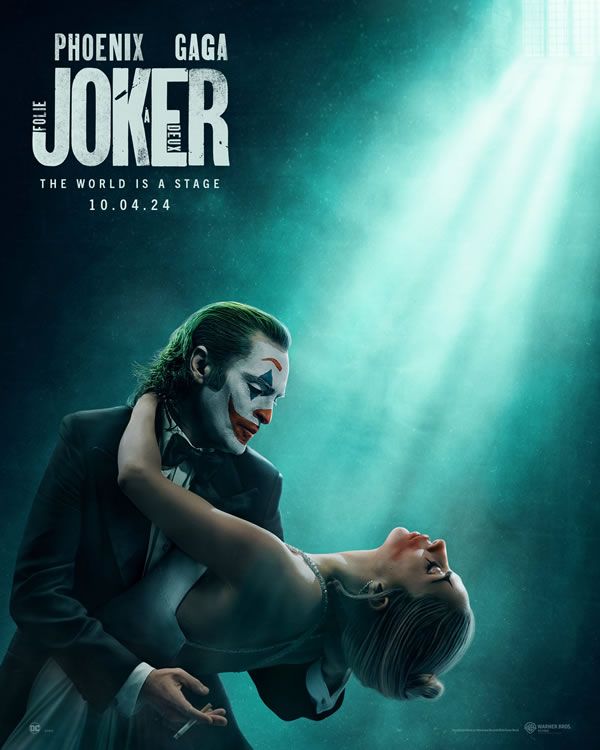
Joaquin Phoenix embodied a languid Joker with mental health disorders, showing the weight of being a lonely person with few opportunities, isolated by society for being “weird,” and who gradually experiences a series of traumatic events, justifying the violent being he becomes.
Phillips remarked at this year's Venice Film Festival, where Joker Folie à Deux competed for the Golden Lion, that his saga is about identity. After seeing the positive reaction to the alternative origin of this antagonist, he and Phoenix decided to push even further beyond what had been done before, creating something “as crazy and bold” as the character itself. While the first film defied being labeled a superhero movie, because it didn’t fit that genre, this one does so even less.
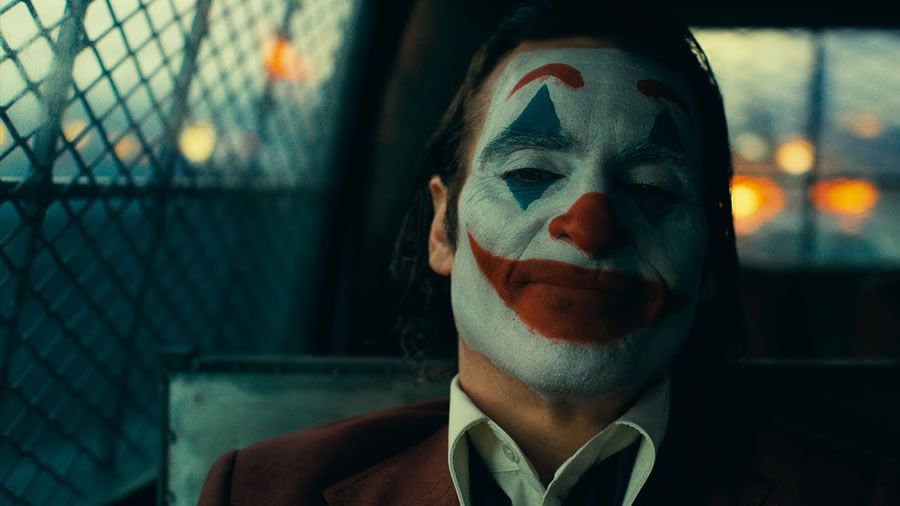
The 2019 film was one of the most realistic and humanized stories ever told about the Joker. Although this sequel may seem disconnected from the first due to its tone, it returns to its core theme—mental health—and confirms this through its title, which comes from the French term for shared madness (folie à deux).
After committing five murders, Arthur Fleck is behind bars, still a near-celebrity inside and outside prison. He has been sent to Arkham Asylum two years after his crimes, awaiting a trial that could give him a fair sentence. His lawyer argues that the murders were committed without him being fully aware of his actions. Arthur seems to have had a relatively calm few years, but his traumas are reactivated when he meets Lee Quinzel (Harley Quinn) during a music therapy session—a patient who expresses her obsessive and destructive love for Arthur. From there, everything is set for their shared madness to escalate.

While Joker delved into madness as a psychological thriller turned tragedy, Folie à Deux unleashes all that madness with an erratic and diminished character who seems unsure of what direction to take. Those around him want to see him as a comedian, his lawyer as a victim of society, and Quinzel and others from the streets as the figure who sparked their rebellion. But whom should Arthur listen to?
In cinematic terms, Phillips drives this mental revolution with a story that constantly and abruptly changes genres and tones, making it feel like four films in one. Joker Folie à Deux never abandons Arthur; this saga continues to focus almost exclusively on him. It’s a drama, a toxic romance, a superhero fantasy (the closest it gets to what audiences might expect), a courtroom film, and a musical—all in one. This genre-shifting approach has caused the most conflict among fans of superhero films.
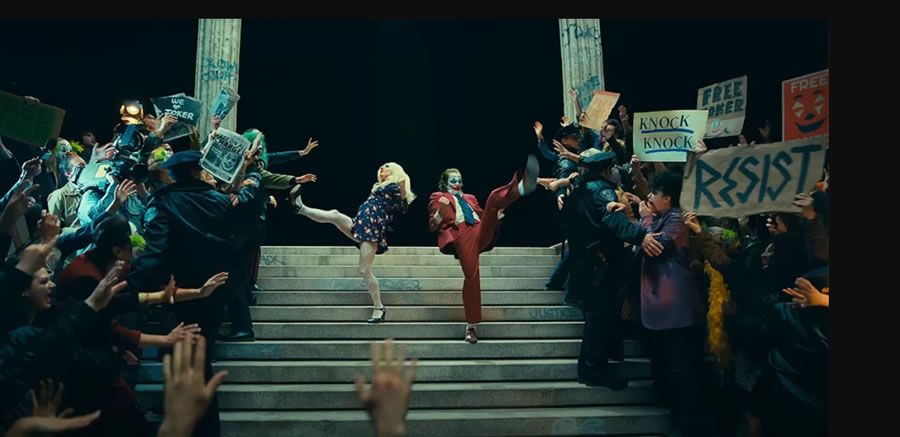
Arthur constantly experiences dissociative episodes, which in the film are represented through musical sequences. This is how the audience is immersed in the mind of a man who creates a friendly world where he is understood, accepted, and celebrated. This constant change in rhythm and tone is stimulating, especially in a cinematic landscape that had become overly reliant on the shadow of Nolan’s formalist and dark Batman trilogy or the long, thematically identical, adventurous, and comedic sagas from D.C. Comics or Marvel. These franchises often err on the side of too much reverence on one hand, and a lack of innovation and risk-taking on the other.
However, since Joker Folie à Deux is essentially several films in one, not everything works equally well, although its erratic nature serves as a coherent follow-up to the first film. The musical elements, which take a more prominent role than expected in a superhero film, are the least problematic—although many will argue that this is its biggest issue. Phillips meticulously handles every detail, from Gaga’s controlled and restrained performance to the selection of musical numbers and songs that lean toward sobriety and nostalgia, serving as a prelude to Fleck’s inevitable fate. The biggest problem lies in the courtroom sequences, which occupy a significant portion of the plot but don’t reach their full potential. Additionally, the mental health defense, the cornerstone of both films, is not as convincing as it should be.
Lady Gaga’s character might seem like a distraction due to the musical numbers and her marginally developed backstory and motivations, but in reality, her character is crucial to the sequel’s aims: to explore collective madness and, in the case of the Joker, to kill the man and give birth to the symbol—the symbol of violent revolution.
Thus, in these two films, Todd Phillips offers a deep dive into the psyche of a villain, a character with a dark personal past, overcome by his own evil, and who, almost unintentionally, becomes a figure representing a dissatisfied sector of the city. Superhero fans, who may have expected a Joker terrorizing Gotham City while weaving one of the usual conspiracies seen in these kinds of stories, may not be satisfied with the result. But what the director has done here is give a fitting conclusion to Arthur Fleck while leaving the Joker, Batman’s ultimate enemy, alive and full of possibilities.
Technical Details
Director: Todd Phillips Genre: Musical, Psychological Thriller Screenplay: Scott Silver, Todd Phillips Duration: 138 minutes Produced by: Todd Phillips, Emma Tillinger Koskoff, Joseph Garner Cast: Joaquin Phoenix, Lady Gaga, Brendan Gleeson, Catherine Keener, Zazie Beetz Cinematography: Lawrence Sher Editing: Jeff Groth Music: Hildur Guðnadóttir Country: United States Year: 2024
<< Go to Spanish version