
11/12/2024
Review The Room Next Door or the Purest Form of Human Empathy
"First me, second me, third me" is a popular phrase that represents an individual need and a collective conflict. It’s a principle that, under the guise of self-care, glorifies egocentrism.
Pedro Almodóvar’s new film, through the reunion of a friendship in an extreme situation, presents the purest act of human empathy.
"Quel est ton tourment?" (What is your torment?) is the literal question that the unnamed narrator of Sigrid Nunez’s novel (2020) asks her friend suffering from a terminal illness. This question originates from an essay by philosopher Simone Weil, who delves into the concept of “true attention to the other,” which involves letting go of oneself in order to understand, help, and show compassion for someone in need.

Nunez’s novel is structured through moments filled with confessions, visits, observations of everything, nothing, and oneself, and encounters that explore life, friendship, and death, all while avoiding melodrama.
Almodóvar, in his first film in English, takes a slightly different approach by focusing on adapting two specific episodes from the novel, letting the relationship between the protagonists guide the story.

Plot Overview
Ingrid (Julianne Moore) is a successful novelist promoting her latest book. Martha is a war reporter diagnosed with terminal cancer. After serving as a test subject for a new treatment, she’s informed that it hasn’t worked, and her illness continues to progress. The two women were once very close friends in their youth, even sharing a boyfriend at one point and working together at a magazine. However, their careers took them in different directions, and they lost touch. Through a mutual friend attending one of Ingrid’s book signings, Ingrid learns of Martha’s condition and that she is now hospitalized.
Without hesitation, Ingrid decides to visit her, only to find that their bond remains as strong as ever. She discovers that Martha is truly alone and desperately needs someone to listen. At one point, Martha suggests that Ingrid accompany her to a house in upstate New York—a peaceful place where she has decided to end her life through euthanasia, having acquired a pill on the black market.
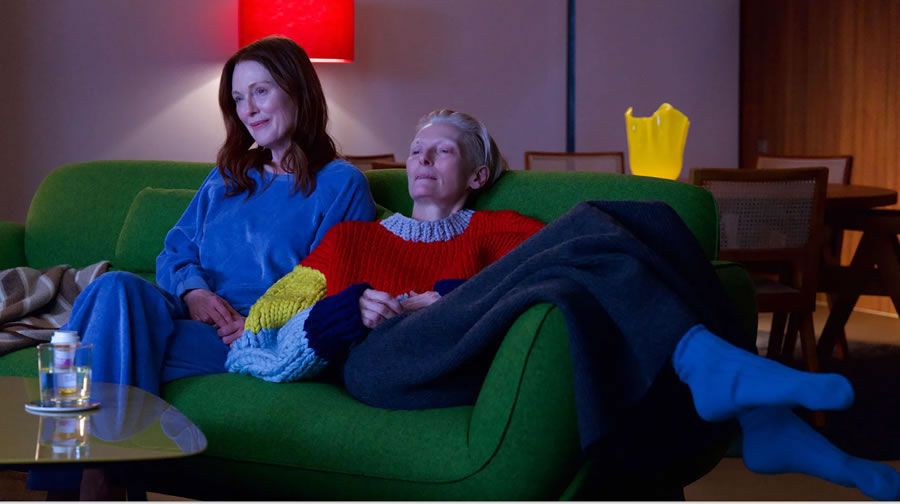
As the illness consumes Martha, her perception of time and concerns slow to a crawl. For Ingrid, however, the days become frenetic and challenging. She feels torn between putting her writing on hold to support her friend and continuing with her work while trying to be present and processing the plan to avoid legal issues once Martha is gone.
A Cinematic Masterpiece of Empathy
Elegantly stylized, Almodóvar, much like the original author, avoids melodrama. Instead of sadness, witnessing Martha’s final weeks is filled with light and brilliance, a vitality reflected in the rekindled friendship between the protagonists. Despite the inherent drama and melancholy of a life nearing its end, there are no grim or dark elements. On the contrary, vibrant, intense colors symbolize the transformation of their connection—a transition, or rather, the continuation of one existence into another, from a deeper understanding of death.

Almodóvar weaves a meticulously detailed and delicate story. His film, however, would not have been possible without two seasoned actresses whose minimalist and ultra-realistic performances capture the torrent of thoughts and existential reflections that the story demands. Martha’s lengthy monologues would not have the same impact without Tilda Swinton’s precise and committed portrayal, nor would they reach such emotional depth without the poignant silences, glances, and expressions of Ingrid, masterfully executed by Julianne Moore. The virtuosity of both actresses ensures that these dialogues never become tedious. Almodóvar’s writing, imbued with poetic tone, brings the novel to life visually.
Ingrid is a beautifully crafted character, undergoing her own growth process in a short span and without asking for it. She embodies selfless love and pays homage, through fiction, to caregivers who take on the hard yet wise task of accompanying the terminally ill with nothing more than their own presence, embracing silence rather than empty, soulless words or advice.
Themes and Characters
Amid memories, laughter, helplessness, fear, uncertainty, and expressions of femininity, the deeply emotional and intimate The Room Next Door confronts the profound weight of true friendship. It redefines the dying process as a passage that, under any circumstances, should be approached with tranquility, dignity, and without drama. Above all, it reminds us that empathy should have no exceptions or limitations.

The film revolves around these two central characters, but also introduces two peripheral figures who complete the story: Martha’s nearly forgotten daughter and Ingrid’s love interest, Damian Cunningham, who once dated Martha. Damian (played by John Turturro) is a pessimistic writer critical of today’s world. Through his character, Almodóvar takes the opportunity to deliver his signature (apocalyptic) critique of the dangers posed by the intersection of neoliberalism and the far-right. However, while Almodóvar’s political commitment is well-known, in this context, it feels like an added layer without real relevance to the plot.
Conclusion
This is one of the most beautiful films on the subject of euthanasia. It’s Almodóvar at his finest. The Room Next Door is a marvel of serenity, meditative reflections, and deep connections. Undoubtedly one of the best films of the year.
Technical Details
Director: Pedro Almodóvar
Screenplay: Pedro Almodóvar
Genre: Drama
Duration: 106 minutes
Produced by: Agustín Almodóvar, Esther García
Cast: Tilda Swinton, Julianne Moore, John Turturro
Editing: Teresa Font
Cinematography: Edu Grau
Music: Alberto Iglesias
Country: Spain
Year: 2024
<< Go to Spanish version