
09/23/2024
Review The Substance - Coralie Fargeat's Bomb on the Cult of Beauty
"The Substance" by Coralie Fargeat is a liberating bombshell, marking the best horror film of the year so far. The movie is a satire on the female body and the cult of beauty.
The midlife crisis is no myth—I've experienced it myself. Nowadays, it may be even harsher, driven by intense competition, social media, cancel culture, radicalism, and the increasingly early notion of labeling people in their 40s as elderly.
Coralie Fargeat went through this crisis herself, and her response is this fierce, wild, and exhilarating film about female bodies—bodies that are despised, degraded, and ultimately explode as a means of liberating the territory society has mistreated.

Harvey is an unpleasant man (akin to Harvey Weinstein). He runs a fitness program studio that has thrived for decades, with its main star, Elisabeth Sparkle. Now in her 50s, Elisabeth's figure remains intact, but her face shows the natural signs of aging. This displeases the studio, which seeks a fresher face for its eager audience. After being fired, she receives a mysterious lifeline: a substance that promises, with no turning back, to restore her to the beauty standards expected of her. This technology creates a duplicate, an improved version of her, with whom she must learn to coexist. This double has a degree of autonomy, living Elisabeth's life every seven days while Elisabeth herself serves as a source of plasmatic nourishment. Their existence depends on each other, and the terms of this symbiosis are inalterable.
Feeling the societal pressure and isolation, despite her ability to remain socially and professionally active—much like Fargeat’s own crisis—Elisabeth agrees to take the substance. Her new double, Sue, is a flawless 20-something who effortlessly steps into her role in the program, much to Harvey’s delight and the renewed approval of the show’s audience. But as films like Ex Machina have shown, the autonomy of androids or AI comes with risks. Sue, increasingly seduced by a world that worships her, starts sabotaging the woman who brought her to life, aiming to prolong her own time in the spotlight. Now, Elisabeth finds herself not only canceled by her peers and forgotten by her fans but also threatened by her own double.
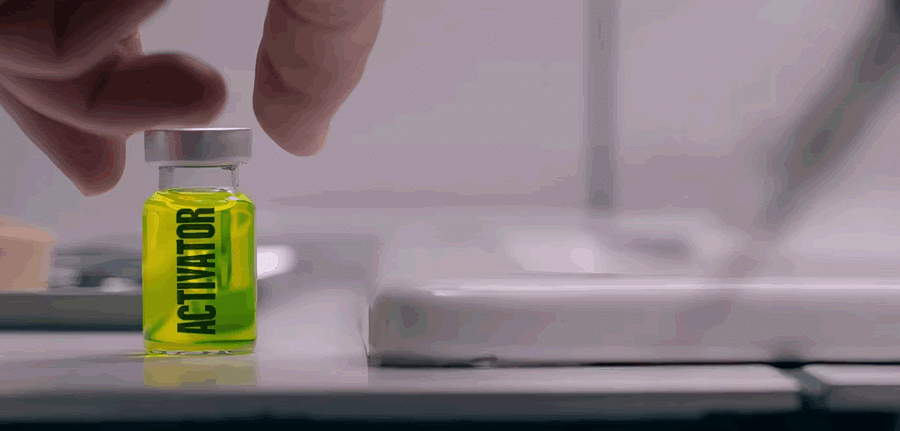

This is where “The Substance” truly begins, offering a furious and unrestrained mirror-satire of beauty culture—a place where the body is cannibalized in a slow, cruel process, shown with bloody and scatological excess. Fargeat holds nothing back, prioritizing action over dialogue in a script that emphasizes the violence inflicted on the female body. The scenes featuring Sue, full of close-up shots of her lips, breasts, buttocks, and tender skin, evoke American Beauty in their longing for eternal youth, commodifying and fetishizing the female body. Meanwhile, Elisabeth’s physical deterioration—her body manipulated, tortured, and ridiculed—reflects how societal pressure forces us to hate aging, driving us to self-destruction in the quest to fit in.
The Connection to Demi Moore’s Career

In this battle against the cult of the body, director Fargeat centers the film on Demi Moore, an actress who was part of the Hollywood star system and became a sensual female icon in the 1990s. Moore even received the highest salary ever paid to an actress for her role in Striptease (1996), where she played Erin Grant, a single mother working as an exotic dancer fighting for custody of her daughter. Moore underwent rigorous training, diets, and exercise to meet the physical demands of her character, reflecting the objectification of women in films at the time.

Moore's career was heavily influenced by her physical appearance, as seen in another pivotal role as Diana Murphy in Indecent Proposal, where her physical beauty becomes the gateway to an irresistible offer that could solve her and her partner's financial problems. While her career didn’t end, Moore’s prominence faded as superhero franchises emerged in the 2000s, and the industry stopped making these high-budget adult dramas.

Now 61, Moore is a perfect choice to play a woman who has been shaped and glorified by society and is now facing oblivion. In The Substance, Moore delivers her best performance yet, fearlessly exposing her sixty-something body without any of the stylization of her golden years. It’s a bold and uninhibited portrayal of things once hidden: ugliness, ridicule, deformity, and discomfort. Margaret Qualley (Sue) was right when she said this is Moore’s film.
The Aesthetic
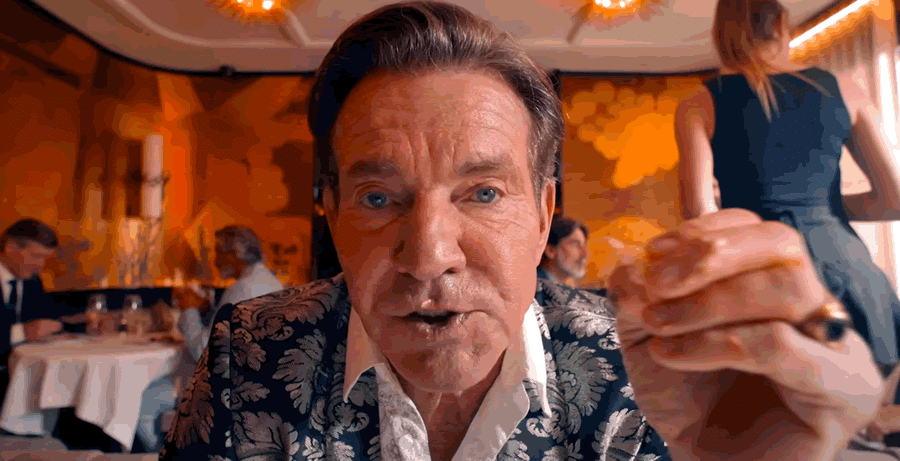
The Substance offers a unique visual experience with its ultra-polished aesthetic. The softened, clean, and bright lighting emphasizes the setting of a fictional Hollywood (shot in France). The cinematography uses special filters and diopters to create sharp close-ups and elongated character figures, enhancing the distorted reality with practical and visual effects. Despite the high cost and extended 100-day shoot, Fargeat's commitment to these techniques pays off.


Coralie Fargeat’s liberating bombshell against body worship is both a serious social satire and pure fun. She also takes a small revenge by stereotyping men as foolish and unpleasant, while flaunting body-horror sequences with nods to masters of the genre like Cronenberg and Carpenter, and films such as The Elephant Man and The Brood. Notably, she includes two unforgettable references to The Shining and Carrie, surpassing the latter's iconic bloody scene.
With The Substance, Fargeat unleashes her inner monster, spewing 141 minutes of raw, bitter truths about the never-ending cult of the body and beauty. The film is a true marvel of fiction and a future essential in horror cinema history.
Technical Information
Director: Coralie Fargeat
Screenplay: Coralie Fargeat
Duration: 141 minutes
Genre: Body-Horror
Producers: Coralie Fargeat, Tim Bevan, Eric Fellner
Cast: Demi Moore, Margaret Qualley, Dennis Quaid
Music: Raffertie
Editing: Coralie Fargeat, Valentin Feron, Jerome Eltabe
Cinematography: Benjamin Kracun
Countries: UK, USA, France
Year: 2024
<< Go to Spanish version