
06/21/2023
EO: A Heart-Wrenching Road Movie Reflecting Human Cruelty and Environmental Devastation
The successful journey of "EO" began in Cannes 2022 after winning the Special Jury Prize and the Cannes Soundtrack Award in the official competition. Jerzy Skolimowski's film was nominated for Best International Feature Film at the previous edition of the Oscars.
"EO" is a heart-wrenching road movie about a donkey - portrayed by six of these animals - that also serves as a fable about human cruelty and arrogance.
There is an anecdote behind this film that the Polish director shared with the MUBI Notebook magazine, which takes him back to the early stages of his career. It was the year 1966 when both he and Robert Bresson were releasing their new productions; the Frenchman with "Au Hasard Balthazar" and he with "Walkover," his second feature, which received the approval of Cahiers du Cinema magazine, listing it as the second favorite film of the year. Skolimowski, excited and grateful, was curious to know which film was ranked first. The chosen one was Bresson's film, a story about a donkey that goes through a cruel journey when separated from its beloved owner, disrupting its stability and the comfort it had lived with until then, passing through various hands. Skolimowski went to watch it and was deeply moved, even to tears. "Bresson taught me that an animal character can move the audience even more than the best human performance," he commented. Many years later, this memory came back to him when he desired to narrate a story in a non-linear way, to tell it differently, and he came across a donkey that appeared on his path by chance, which was a perfect fit because it allowed him to create a story almost devoid of dialogues, something he finds boring.
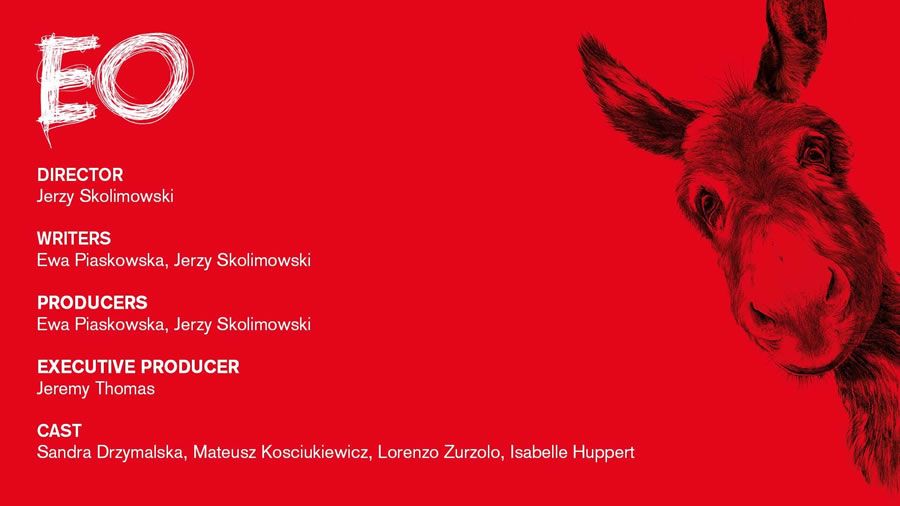
In 2022, I watched over 150 films. "EO" has been, by far, my favorite feature film. The story of a donkey, starring a donkey, on a tender and heart-wrenching journey through almost half of Europe has been unparalleled for me. As you can see, after learning the anecdote, this story is inspired by the classic by the French filmmaker.
In Bresson's film, Balthazar is a donkey adopted by some children on a farm. After the death of one of the family members, he passes through the hands of several owners, where he experiences exploitation and mistreatment in his adulthood until he accidentally escapes and reunites with his most beloved owner, who also faces the harshness of life in parallel. Skolimowski's vision in his film, on the other hand, focuses exclusively on EO, a donkey that is part of a circus and has a very special connection with the dancer Kassandra, his show partner. The happiness and tranquility with which he has lived until now are interrupted when a group of animal rights activists presses for his release, resulting in him being separated from his caretaker and left adrift, passing through many hands and various places and European countries, just like Balthazar.
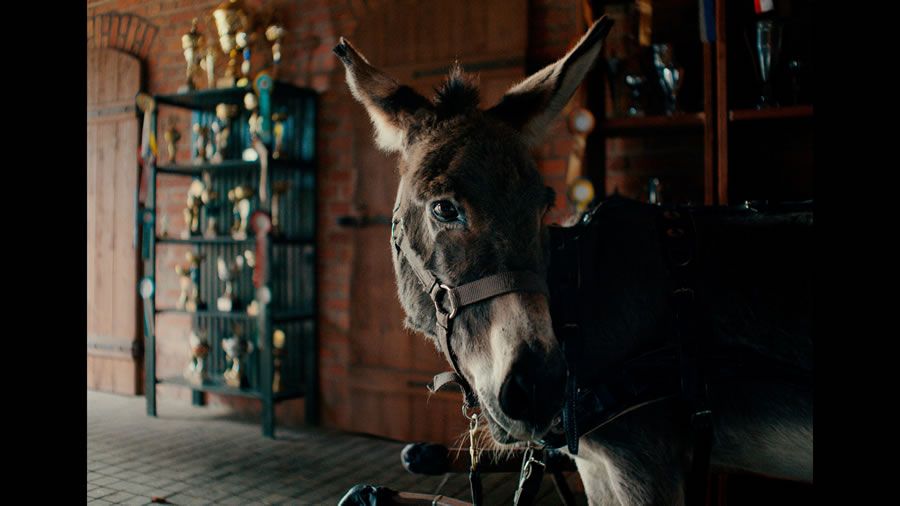
The director warns, on the screen itself, that his film is made out of love for animals and nature, so what we see is a radicalized perspective of that love for these sentient beings. In other words, what we observe in EO is clearly intended to shatter us from the first few minutes, because this mammal will make efforts to reunite with Kassandra, and she will also try, at least, to see him one last time.
This is a road movie where a donkey takes the journey on the road amidst a sea of emotions that are skillfully conveyed to us through camera close-ups, great editing, and the use of several donkeys, where we can intuitively perceive fear, uncertainty, pain, hunger, and loneliness in their large expressive eyes. There is no way to come out unscathed from this film. There are certain viewers who tend to get irritated with stories where they feel manipulated, where they are driven to tears, pity, or pain at all costs. These are the types of reluctant criticisms some make of Darren Aronofsky and, more recently, of Brendan Fraser in his emotional and sad film "The Whale," or of Nadine Labaki for the alleged exploitation of misery in her excellent "Capernaum." But sometimes they are necessary.

Skolimowski confessed that he hadn't cried since Bresson's film and he wanted to evoke those emotions with his new production. Although it may seem manipulated, he managed to convey those feelings of the animal with great patience during the filming, considering their stubbornness. "The main difference is that donkeys don't know what acting is; they can't pretend anything, they simply are. Donkeys are kind, affectionate, respectful, polite, and loyal. They live fully in the present moment, never show narcissism, do not spare any supposed intentions of their character, and never question the vision of their director. They are excellent actors."
The greatness of EO is that it is a character who takes on the role of an observer, an external observer interested in human life and behavior. He is clearly not like us, and the film is capable of translating his reactions to the actions that unfold before him. Not everything is sad in EO; animals with their innocence and naivety can be funny and empathetic, happy with very little and focused on the present, aspects that we, the superior thinkers, tend to forget and overshadow. But beware, although there are some luminous and comedic moments where humans show kindness, that is not what the film aims to highlight. This contemporary fable speaks of human arrogance and absurdity. EO's silent encounters with humans, beautiful places, and other animals reflect the consequences and devastation we are causing and how disconnected we are from nature.
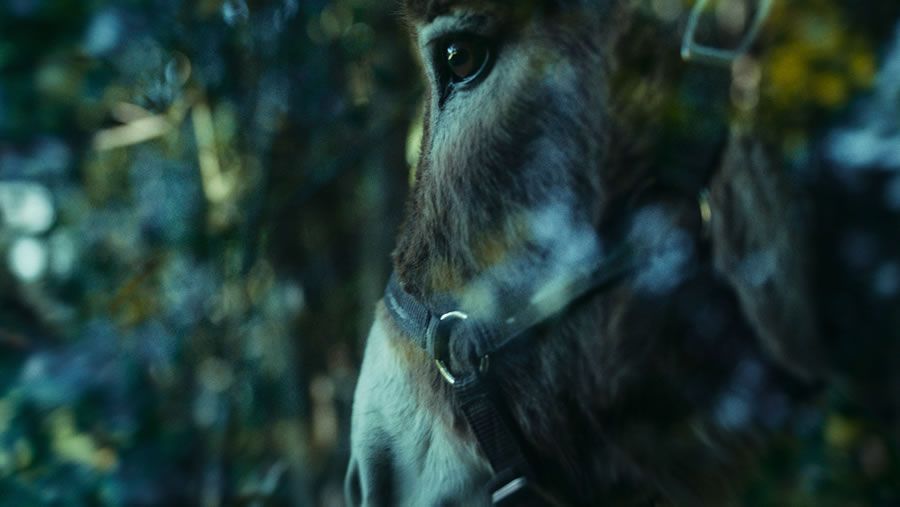
In that sense, EO also serves as an anguished, sad, and heartbreaking environmental call. I watched it in December, and it still lingers in my mind. By the way, you can find Bresson's film on MUBI.
Part of this review was published by Sandra M. Ríos in the newspaper El Nuevo Siglo on March 3, 2023.
<< Go to Spanish version