
07/05/2023
Review "Asteroid City" – The Cinematic Cosmos, Theater, and Wes Anderson's Reality
At the end of the 1940s, the mythical incident of Roswell occurred (in three days, it will be 76 years since that curious event), in which the United States Army reported the recovery of wreckage from an unidentified flying object that crashed on a ranch near Roswell County, New Mexico. The local newspaper documented the event, providing a description of the object, and it was widely disseminated by other media outlets. Days later, the authorities changed their version, claiming that it was the crash of a balloon belonging to the Mogul project.
For over three decades, there seemed to be no major suspicions about the official change in this story until a couple of researchers debunked the Mogul theory. They pointed out that the project didn't begin testing until 1953, six years after the alleged "UFO" sighting. Mogul was a secret project by the United States aimed at spying on the Soviet Union to gather information about their atomic tests.
Since then, the Roswell case has been widely exploited by the ufology community and conspiracy theorists, who not only discussed the incident but also claimed that at least one alien was found and taken to Area 51 (another great mystery). You may recall the famous image of the autopsy of one of these beings. Pop culture has not forgotten the incident either, as it has been depicted in countless TV series like "The X-Files" and "Taken," movies like "Independence Day" or the comedy "Paul" (which does remind me of what's mentioned here), as well as books, songs, and video games.
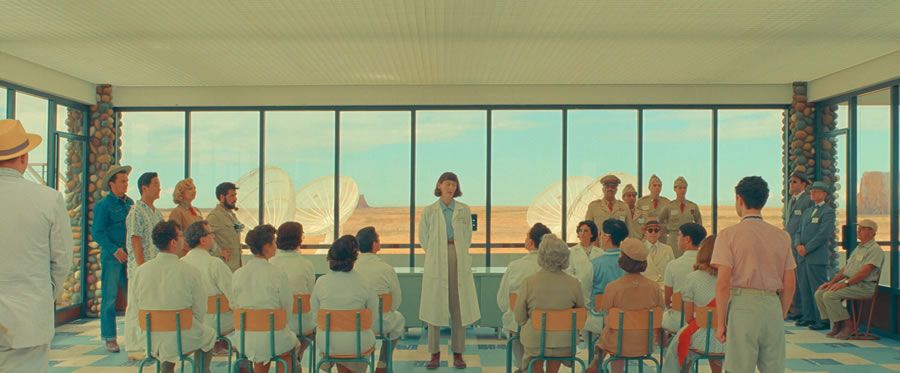
Wes Anderson's new film unexpectedly evokes Roswell. The feature film is set in the 1950s in a fictional region called "Asteroid City," where a group of parents with their children arrive at a camp for young geniuses and astronomy enthusiasts. It's a desert-like place that is occasionally interrupted by the mushroom cloud produced by nuclear tests. The enthusiastic kids, along with their parents, find themselves trapped in that place after having a close encounter of the third kind during a night of cosmic exploration (like those in Spielberg's films). The authorities decide to cover up the event, unaware that the daring youngsters plan the opposite. In our reality, "Asteroid City" is set in the post-war period, where fears of an atomic bomb found expression in alien movies as a way to express those fears and warn about what could be a new destruction—a way to resort to more artificial stories as an escape method.
So, this is the unmistakable Anderson's foray into the realm of science fiction, presented in his usual tone of slightly innocent, light-hearted comedy. The film features a series of cryptic dialogues and messages, like the phrase repeated by a large part of the extensive cast in unison: "You can't wake up if you don't fall asleep." This peculiar extraterrestrial appearance is not the only thing Anderson explores in this film. He takes us to another reality where a theater play named "Asteroid City" is being prepared, and we are shown the behind-the-scenes of the script creation and the director's ups and downs, presented through a television program. The actors exist in both realities as if in a multiverse, where they are also aware, within the movie itself, of the roles they play on both sides, sometimes even breaking the fourth wall. It is this consciousness that makes them question the roles assigned to them and express uncertainties, fears, desires, and resort to nostalgia. They are characters who, like us, seem to be spectators of their own destiny because there is the figure of a Creator who controls their lives.
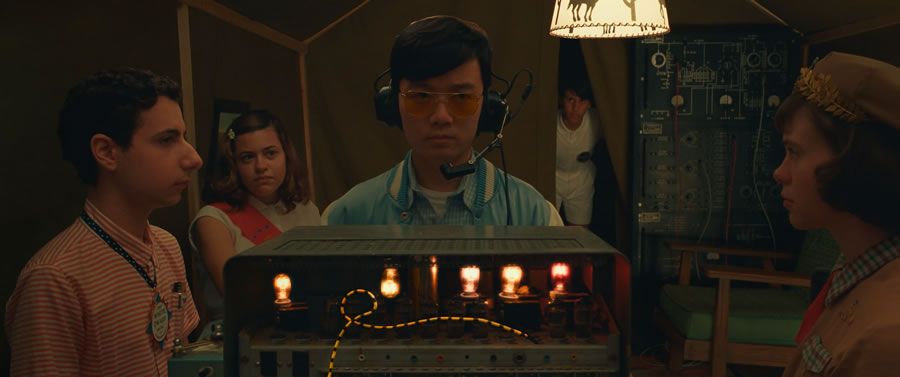
Anderson has sought to create a kind of existentialist story that involves the cosmos, evokes the past, and desires a hopeful future, ifyou will. It also explores themes of family, grief, love, parenthood, and above all, art—the process and challenges of art. That's why "Asteroid City" has been labeled as a drama-comedy, but in reality, it is unclassifiable, much like its creator. All of this is conveyed in a single story, distinguishing the two realities with a switch between color and black-and-white. These events unfold with high individual aesthetic value but are difficult to fit into a cohesive narrative that would make this story a convincing sum of good ideas.

Edward Norton portrays a playwright who, at some point, responds to the question of what the play is about, answering that it's about infinity and not knowing what else. This phrase could be a good clue to understand that what Wes Anderson has delivered this time is a film that, like life itself, is a succession of bitter, joyful, fortuitous, transitory, and surprising events that emerge out of nowhere and do not require further explanation. It also highlights that cinema and theater are capable of constructing another believable reality.

Despite the narrative stumbles and significant gaps, Anderson's filmmaking remains hypnotic due to his well-known aesthetic rigor—a visual pleasure and an excuse to return to the big screen to see a director with a unique style, almost like a genre in itself. It's also an opportunity, as he says, to allow oneself to dream for 105 minutes and then (finally) wake up and continue in our own reality.
Technical Details:
- Director: Wes Anderson
- Screenplay: Wes Anderson
- Duration: 105 minutes
- Produced by: Wes Anderson, Jeremy Dawson, Steven Rales
- Genre: Comedy, science fiction, drama
- Cast: Scarlett Johansson, Jason Schwartzman, Tom Hanks, Edward Norton, Bryan Cranston, Tilda Swinton, Adrien Brody, Jeffrey Wright, Matt Dillon, Houng Chau, Liev Schreiber, Steve Carell, Margot Robbie, Willem Dafoe, Maya Hawke, Hope Davis, Stephen Park, Jeff Goldblum, Tony Revolori
- Cinematography: Robert Yeoman
- Editing: Barney Pilling
- Music: Alexandre Desplat
- Country: United States
- Year: 2023
<< Go to Spanish version