
06/02/2023
Explore a Dystopian Square Society in "The Other Shape": Award-Winning Colombian Animated Film
After its release in Colombian theaters a couple of months ago, the feature film "The Other Shape" will be available on the local platform, RTVCPlay, of the public channel starting this month.
Directed by Diego Felipe Guzmán Ramírez, the production received the Best Animated Feature Film award at the 2022 Sitges Film Festival in Spain.
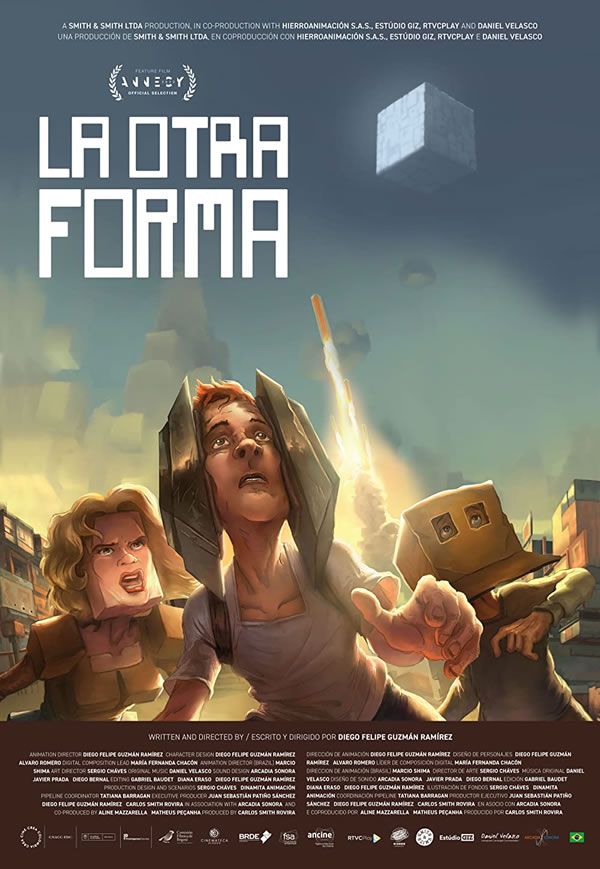
"The Other Shape" is primarily a film for an adult audience that follows the story of a man obsessed with fitting into a society where everything is square. It takes place in a near-future dystopia where humanity has created an artificial square paradise on the surface of the Moon, which everyone aspires to reach by conforming to the condition of being square, both in their physical appearance and way of thinking. To achieve their goal, society uses all kinds of devices to modify their bodies. In the protagonist's quest to reach the lunar paradise, he faces the dilemma of either remaining like everyone else or being truly authentic. Behind this story lies a critique of modern society's focus on individuality.
With the support of the Colombian Cinematographic Development Fund (FDC) for animated productions, these labor-intensive films have been able to be made, as they can take up to eight or ten years to complete in many cases. Guillermo del Toro's award-winning "Pinocchio," for example, took 15 years to make with the support of the giant Netflix.
Colombia has been exploring animation in cinema since the early 1980s with Fernando Laverde's "Cristóbal Colón," and over time, it has improved techniques and developed more complex stories to be told not only for a child audience but also for adults in both fiction and documentary genres, addressing topics such as violence and war. In 2011, the national film industry released its first 3D animated feature with the documentary "Pequeñas voces" by Jairo Carillo and Oscar Andrade, which reached the Venice Film Festival. Since then, nearly 40 titles have been produced.

"The Other Shape" joins other daring and unique projects such as "Gordo, Calvo y Bajito" (a comedy made in rotoscoped animation) and "Virus tropical," the first adaptation of a graphic novel in this format that also targets an adult audience. Furthermore, this dystopian film is part of the limited list of Colombian science fiction movies. Set in the near future, the story follows Peter Press, who has lived with a presser on his head for 20 years. In the movie's immersive world, society must live morphologically and mentally in a square manner. We don't know what happened to Earth, but an artificial paradise—obviously, square—has been built on the Moon that everyone aspires to reach, as long as they remain confined in their closed bodies and minds. To achieve this, they mold their bodies through plastic surgeries or, like Peter, by force. He has been trying to fit into society all this time, but an incident leads him to discover a "new shape," setting him on a journey where he realizes that his nature is in danger and he must decide which path to follow.
In this vision of the director (animator and visual artist Diego Guzmán), we see references to the cyberpunk environment of "Blade Runner," and humanity is depicted as fearful and obedient, resembling the social structure described by Orwell in the classic "1984." Along Peter's almost tortuous journey, other characters appear, including a woman who represents the beauty stereotype that everyone has accepted but whose own body breaks free from its comfort and demands liberation.

"The Other Shape" demands the viewer's full attention to fully grasp the story since the characters' names are not known, and there is no dialogue throughout the film. We constantly infer and speculate about the film's themes and its intended destination. It becomes a demanding exercise where not everything is understood with the clarity that the director intends, but it is precisely part of its charm and virtue. Conventional narrative structures often dull our ability to connect stories like these.
Of course, there is a sort of warning here that prompts us to question why modern society has become so intolerant of different ways of thinking, especially after the rise of social media. It raises questions about why, as a society, we are censoring what is different and prefer to adopt the comfortable position of the masses, even in our consumption habits.

With a team of over 100 people, including artists, illustrators, animators, colorists, and more, Guzmán commented that the story originated from wondering why everything around us looks square. "We began to speculate and fantasize about whether there is some kind of worldwide squared order that wants to turn us all into squares. That's how this film's conspiracy emerged, and we realized we had a very interesting theme: to what extent are you yourself and to what extent do you fit into society, which indirectly influences you to become what they want."
"The Other Shape" also participated in the Annecy International Animation Film Festival in France, where it received the Contrachamp award.
Part of this note was published by Sandra Ríos in the newspaper El Nuevo Siglo on March 29, 2023.
<< Go to Spanish version